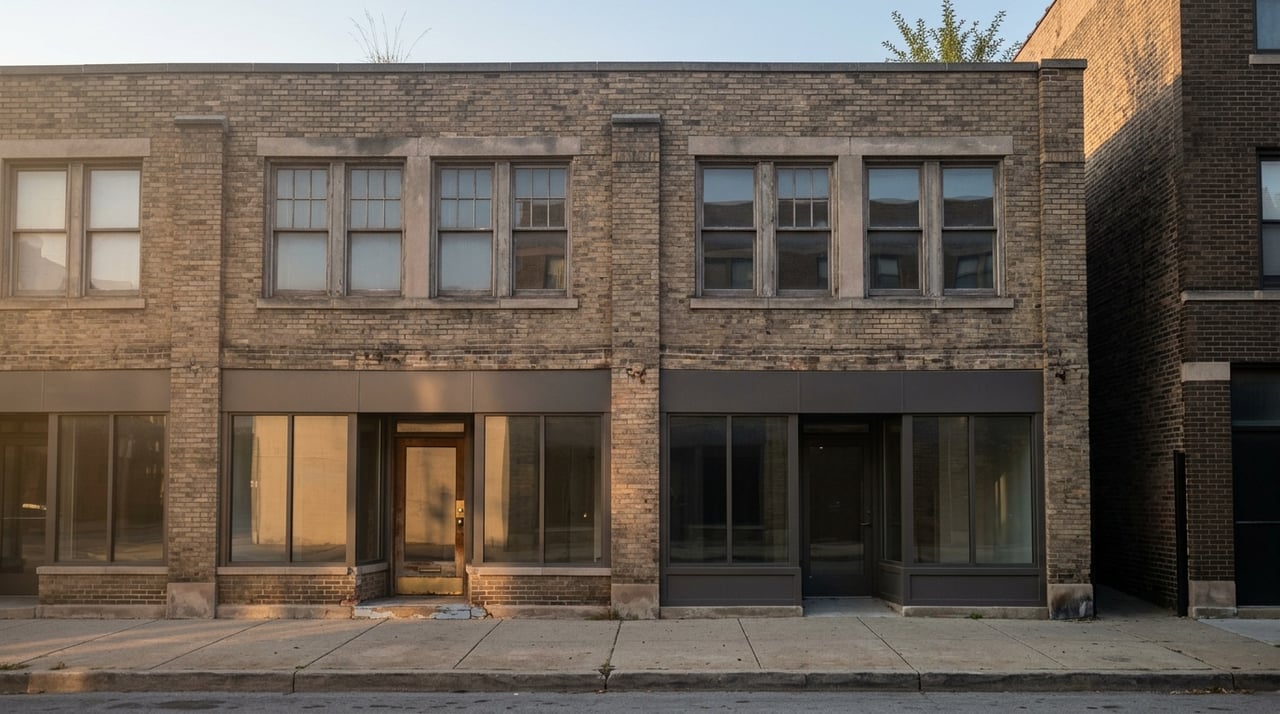
Stand on the platform in downtown South Orange on a weekday morning and you're standing under a small run of storefronts, a bakery, a dry cleaner, a diner, all packed beneath the same brick station that's carried Midtown Direct commuters since 1916. Walk less than a mile away, past the edge of the Montrose Park Historic District, and you'll find a second NJ Transit platform at the corner of Vose and Montrose Avenues. It's quieter. It's older, built a year earlier in 1915. And most of the trains that stop there aren't going to Midtown at all.
This matters more than it should to anyone comparing South Orange listings right now, because almost none of them say which station they mean. "Steps to the train" reads the same whether the walk ends at the downtown platform with its frequent, direct-to-Penn service, or at Mountain Station, where the majority of trains run to Hoboken and a Midtown commute usually means a transfer. Two homes a few blocks apart can be selling the same square footage and a genuinely different daily commute, and in a market this tight, that difference is worth pricing on purpose rather than discovering after closing.
One Village, Two Platforms
South Orange Village is unusual among Essex County towns for having its own in-town rail access at all. West Orange and Livingston, both nearby, have no NJ Transit station inside their borders and rely on driving to a neighboring town's platform. South Orange has two, both on the Morris and Essex line, less than a mile apart, and that redundancy gets marketed as a pure upside. It mostly is. But redundancy only helps if a buyer understands what each station actually offers before assuming the two are interchangeable.
The downtown station is the hub. It sits beside the South Orange Performing Arts Center, a seasonal farmers market, and a small retail row at street level that has included tenants like Cait & Abby's Bakery, Cold Stone Creamery, and the Village Diner. It carries the bulk of the frequent Midtown Direct service, with peak rides to Penn Station commonly falling in the 30 to 40 minute range.
Mountain Station serves a different part of the village, closer to the Montrose and Newstead neighborhoods, with fewer amenities and a quieter, more residential feel around it. Most trains that stop there continue on to Hoboken rather than Midtown, which means a Manhattan-bound rider from Mountain Station typically needs to transfer, either at an intermediate stop for a Midtown Direct train or at Hoboken itself for PATH or ferry service into the city.
The Ride Isn't the Same Ride
That transfer isn't a rounding error. It's the difference between a one-seat ride and a multi-leg commute, and it's exactly the kind of detail that doesn't show up in a listing photo of a walkable, tree-lined block. A buyer who assumes "near the train" automatically means "near Midtown Direct" is pricing a Mountain Station address against downtown comps that were never really comparable in the first place.
South Orange and neighboring Maplewood also run a jitney service to bridge the gap between residential blocks and both stations, organized around routes serving Newstead and Wyoming on one side and Tuxedo Park and Montrose on the other. It's a genuinely useful piece of infrastructure, and it's also not a permanent entitlement. The jitney began in 2002 with a single route and two buses, funded through a New Jersey Transit Community Shuttle Grant tied to the village's designation as a Transit Village. That grant funding is no longer available, and the service, now grown to four routes, is co-funded directly by the Village and the Parking Authority. Riders pay $300 a year for a resident pass, or $450 for non-residents living on the border streets. It works, but it works because the village keeps choosing to fund it, not because it's guaranteed the way the rail line itself is.
The system's fragility showed up directly this year. When Amtrak's Portal Bridge construction forced NJ Transit to reroute trains away from Penn Station between February 15 and March 15, 2026, every South Orange rider, downtown or Mountain Station, was pushed onto a temporary Hoboken-only schedule, cross-honored on PATH and ferry. For a month, the two stations weren't different products anymore. They were the same detour.
A Warning Shot From June
Then in June, NJ Transit proposed something more permanent. The agency floated combining two closely spaced evening departures from Penn Station, the 6:19 and 6:22 p.m. trains, into a single 6:20 p.m. run, and dropping the Mountain Station and Maplewood stops from that consolidated schedule. A commuter named Kadee Shipman noticed the change and started a petition, arguing that eliminating those stops would create real hardship for riders already dealing with inconsistent service. South Orange Mayor Sheena Collum responded by drafting a formal Village Council resolution, one that both pushed back on the change and made a broader case for the town's identity as a transit community, urging NJ Transit to keep working with riders and local officials before finalizing anything.
As of this writing, that resolution and NJ Transit's review are still playing out. But the episode is useful regardless of how it resolves, because it's a live demonstration that Mountain Station's service pattern isn't fixed in stone. It's a scheduling decision made somewhere else, revisited periodically, and a home's commute value near that station can shift with it in ways a downtown-station home is less exposed to.
What Thin Inventory Does to the Question
None of this would matter much in a market with plenty of homes to choose from. South Orange doesn't have that luxury right now. Active inventory in the village fell sharply over the course of July 2026, dropping from 22 homes to just 13 by month's end. That's not a temporary dip. Through the first seven months of 2026, South Orange had recorded 106 closed sales, more than the 92 sold over the same stretch the year before, meaning homes are moving through a genuinely small pool faster than they're replenishing it.
Pricing has reflected that scarcity unevenly. The average sale price in June 2026 spiked to $1,386,811, driven by a handful of luxury closings, before settling back to a more typical $1,148,231 in July. Homes that did sell in July still closed at an average of 115.9 percent of list price after roughly 20 days on market, which is not the profile of a market where buyers can afford to be picky about two variables at once.
That's the practical stakes of the two-station question. With only a dozen or so active listings at any given moment, a buyer who wants both a specific price range and a specific station type may simply not have five options to choose from. Knowing which station an address actually serves, and treating that as a real filter rather than an afterthought, is often the difference between recognizing a good match quickly and losing it to another offer while still figuring out the commute.
How to Check This Before You Write an Offer
A few minutes of diligence settles the question for any specific address. Pull up the actual walking route to the nearest platform rather than a straight-line distance on a map, since South Orange's blocks don't always allow a direct path. Check whether that platform is the downtown station or Mountain Station, since the two sit at very different points relative to most residential streets. If it's Mountain Station, look at the actual weekday schedule for whether the trains serving that stop go to Midtown directly or require a transfer, since the split runs heavily toward Hoboken. And if the jitney bridges the gap for a given address, factor in the $300 or $450 annual pass as a real cost of that commute, not a free amenity.
A Few Common Questions
Do both South Orange stations offer Midtown Direct service? No. The downtown South Orange station carries the bulk of the frequent Midtown Direct trains. Mountain Station sees mostly Hoboken-bound service, and Midtown-bound riders there generally need to transfer at an intermediate stop.
Is the jitney bus a free public service? Not exactly. It's co-funded by South Orange Village and the Parking Authority, with resident passes running $300 a year and non-resident passes $450. It's reliable, but it's locally sustained rather than a guaranteed NJ Transit entitlement.
Does station type really move a home's value more than layout or condition? It's one input among several, not the whole story. But in a market where inventory is this thin and buyers are already paying well above asking, a mismatch between assumed commute and actual station access is the kind of detail that can undercut an otherwise strong comparison between two homes.
If you're weighing a specific South Orange address against what its commute actually delivers, or trying to make sense of a market moving this fast on this little inventory, Cooper McKelvey Real Estate Company can walk the numbers with you street by street. Let's Connect.